
Parts From a Water Boiler
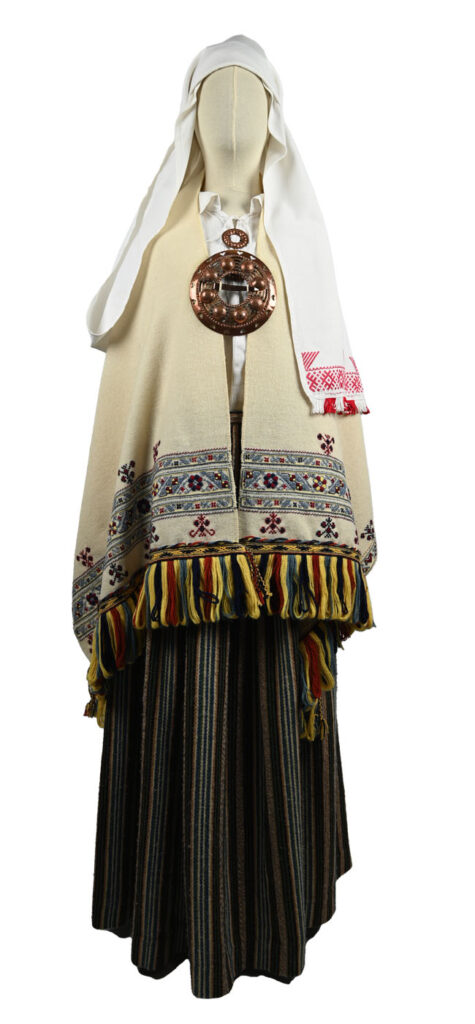
Home > In Exile > Becoming a master folk costume maker > Latvian Arts and Crafts Group in Leeds > Parts From a Water Boiler Parts From a Water Boiler Dignāja folk costume. Made by Rita Jefimova around 1980 in Great Britain. The Dignāja folk costume was made in the Latvian arts and craft group in Leeds in preparation for the English Latvian song days. Rita Jefimova made not only the Dignāja skirt, shirt, shawl and head-wrap, but also the brooches – they were made from copper water boiler parts. Rita remembers: “The craziest part was when we had to weave the skirt because we couldn’t get the right materials. I have a Dignāja skirt that I can hardly wear because it is so thick and heavy. I turned out more like upholstery fabric – we wove with what we had.” Donated by Rita Jefimova. From the collection of the Latvians Abroad Museum and Research Centre (LP2016.340). Rita Jefimova in the Dignāja folk costume in the estate garden of the Latvian centre “Abrene” in France; Easter 1990. Donated by Rita Jefimova. From the collection of the Latvians Abroad Museum and Research Centre. Parts From a Water Boiler Playing Previous Song Play Pause Next Song /
Siberian sewn gown
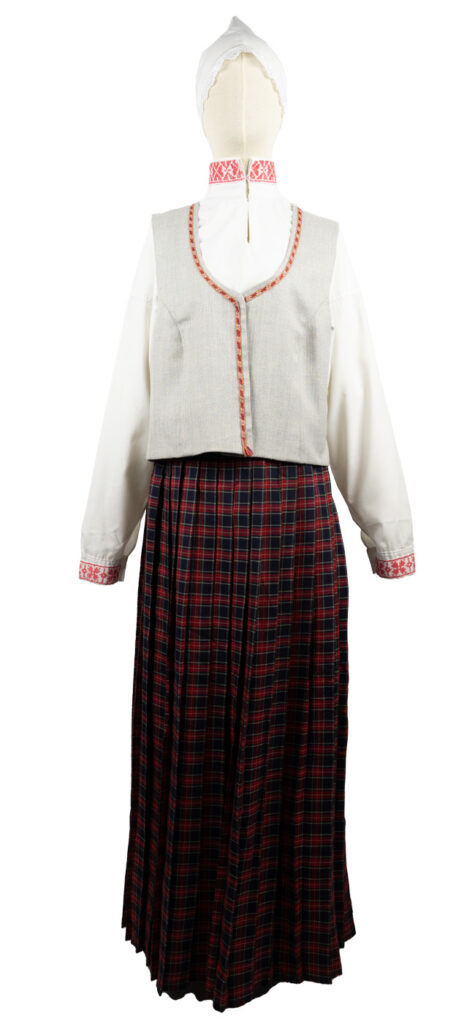
Home > In Exile > “Composite” and adapted folk costumes > Siberian sewn gown Siberian sewn gown Folk costume made in 1997 in Omsk, Russia. This costume was made 25 years ago, when the “Daina” Latvian Folklore Ensemble was established in Omsk, Siberia. The costume was sewn by the daughter of one of the members of the folk ensemble, who is of Polish heritage, but has been part of the Omsk Latvian Society all her life. The shirt was embroidered by a Latvian, Ausma Kuļika. The costume was based on another costume that was owned by the first leader of the folklore ensemble, Austra Iščenko, who was from the Kurzeme province. Members of the folklore ensemble found fabrics in haberdasheries in Omsk that were similar to “real” Latvian folk costume fabrics. The costume was first worn in a performance at the opening concert of the Omsk People’s Friendship Hall. It has also been worn when the “Daina” ensemble has celebrated Easter, Midsummer’s Eve and Christmas, as well as the 18 November – Proclamation day of the Republic of Latvia. The costume was worn when visiting other Latvian communities in Russia, when participating in the Omsk city celebrations and various other events in the Omsk Oblast. The costume has also visited Latvia before – at the Song Festival and the 800th anniversary of Valmiera. The Omsk Latvian Folklore Ensemble “Daina” continues to this day – it has 30 members, who sing and play folk instruments. Today “Daina” members wear folk costumes that have been made in Latvia. Raisa Bakanova, the leader of the ensemble comments that “by putting on a Latvian folk costume, you get a feeling of belonging.” Latvians from Omsk have not lost this feeling even over a number of generations – since the time when Latvian farming colonies were established in Siberia in the second half of the 19th century. Donated by Jānis Tupesis (Latvian Society in Omsk, Russia). From the collection of the Latvians Abroad Museum and Research Centre (LP2023.110). A member of the Omsk Latvian Folklore Ensemble “Daina” in a new folk costume at the Latvian Song Festival in Bashkortostan in 2009. Photo by Arta Savdona. From the collection of the Latvians Abroad Museum and Research Centre.
The Latvian Flag, Hidden in a Maiden’s Headdress
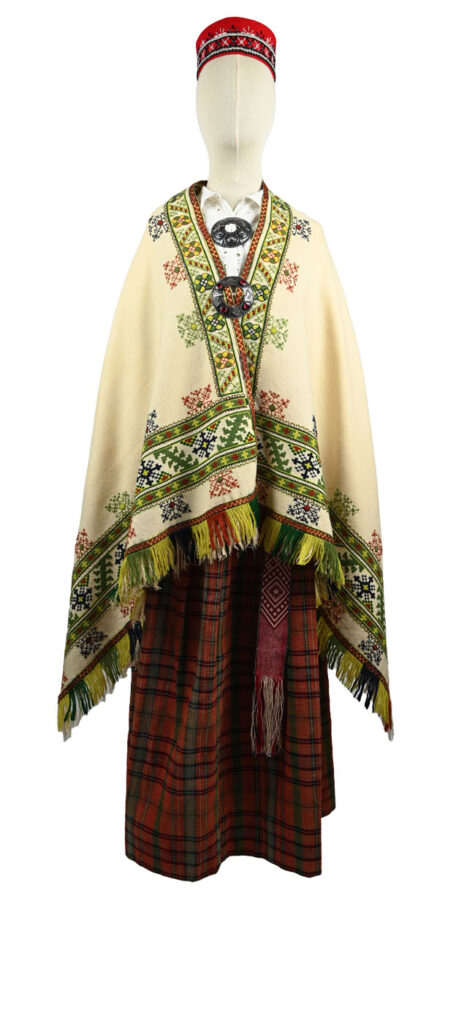
Home > Taken Out of Latvia > The Latvian Flag, Hidden in a Maiden’s Headdress The Latvian Flag, Hidden in a Maiden’s Headdress Krustpils folk costume. Made by Marija Vanags (1911–1950) in the 1930s in Latvia. This folk costume was created as Marija Zapāns’ graduation project at the women’s vocational school of the Latgale Roman Catholic cultural promotion society “Saule” in Daugavpils. The threads from which the skirt was woven were spun and dyed by Marija’s mother using plant dyes. It is said that when Latvia was first occupied during WWII, Marija sewed the colours of the Latvian flag into the maiden’s headdress as a way of protesting against what was happening. When she fled Latvia in 1944, Marija took the folk costume with her. After several years in refugee camps in Germany, Marija and her family emigrated to Australia, where she died relatively young. The folk costume with the family legend of the Latvian colours sewn into the headdress was inherited by Marija’s brother, Jānis Vanags. Donated by Jānis Vanags; from the collection of the Latvians Abroad Museum and Research Centre (LP2014.2). Marija Zapāns (right) with her sister Jadviga Vanaga in Krustpils folk costumes in the 1930s. Donated by Jānis Vanags. From the collection of the Latvians Abroad Museum and Research Centre. The Latvian Flag, Hidden in a Maiden’s Headdress Playing Previous Song Play Pause Next Song /
A Costume For Visiting The President
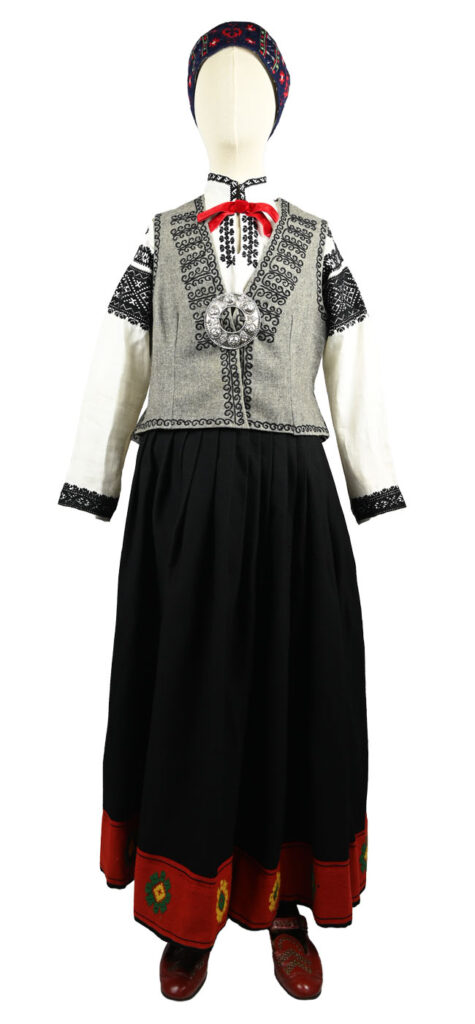
Home > Taken Out of Latvia > A Costume For Visiting The President A Costume For Visiting The President A Bārta folk costume. Made in Latvia in the 1930s. This almost ethnographically accurate folk costume from the Bārta region was made as a gift. It was given to Milda Aparnieks (1902–1985) by her husband, Lieutenant Colonel Artūrs Aparnieks, who had both the folk costume and the silver brooches custom made by master artisans. This folk costume was worn for the first time when Milda went to a reception at Riga Castle with President Kārlis Ulmanis. Milda carefully kept the folk costume throughout her life, taking it with her when she fled Latvia, and later, to Brazil. In 1966 the folk costume and its owner moved to San Francisco, USA. Donated by Aija Švāns, Ināra Aparnieks Burr, Māra Escajeda; from the collection of the Latvians Abroad Museum and Research Centre (LP2015.122) Milda Aparnieks wearing her Bārta folk costume in the 1930s, in Latvia. Donated by Ināra Aparnieks Burr. From the collection of the Latvians Abroad Museum and Research Centre.
A Folk Costume for a Long Jumper
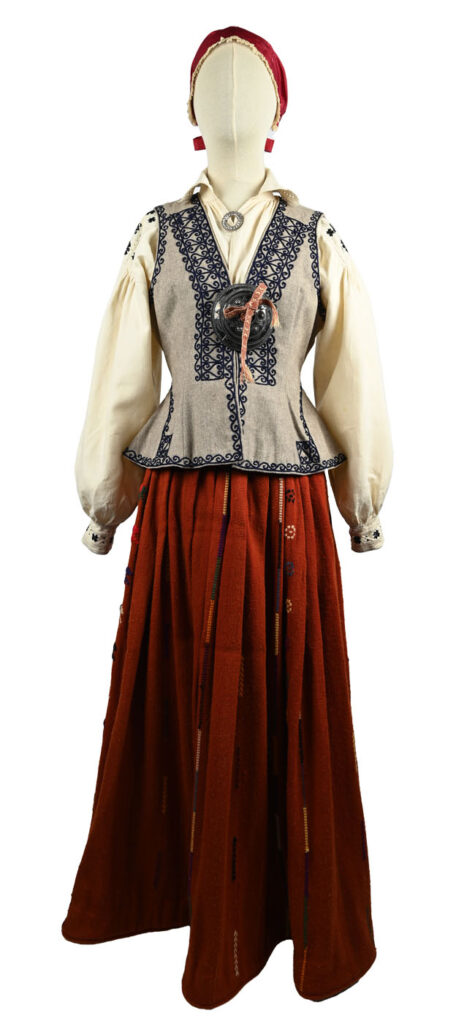
Home > Taken Out of Latvia > A Folk Costume for a Long Jumper A Folk Costume for a Long Jumper Nīca folk costume. Made in Latvia in the 1930s. This folk costume belonged to Zinaīda Zāgars (née Liepiņa, 1907–2000), an outstanding athlete during Latvia’s first independence. As a long jumper, she repeatedly won Latvian championship titles and broke Latvian records in several athletic disciplines. In 1944 Zinaīda became a refugee and eventually emigrated to her new home in the USA. Zinaīda wore the folk costume she had taken with her when participating in various Latvian events, including song festivals. Her daughter Ileana inherited the folk costume. The folk costume briefly visited Latvia again in 1998, when Ileana took part in the Latvian Song and Dance Festival with the Los Angeles Latvian Choir. Donated by Ileana Zāgars-Jones; from the collection of the Latvians Abroad Museum and Research Centre (LP2016.1). Zinaīda Zāgars and her daughter Ileana in Selinsgrove, Pennsylvania, USA; 1950. Donated by Ileana Zāgars-Jones. From the collection of the Latvians Abroad Museum and Research Centre.
Handmade by a Kaucminde Student
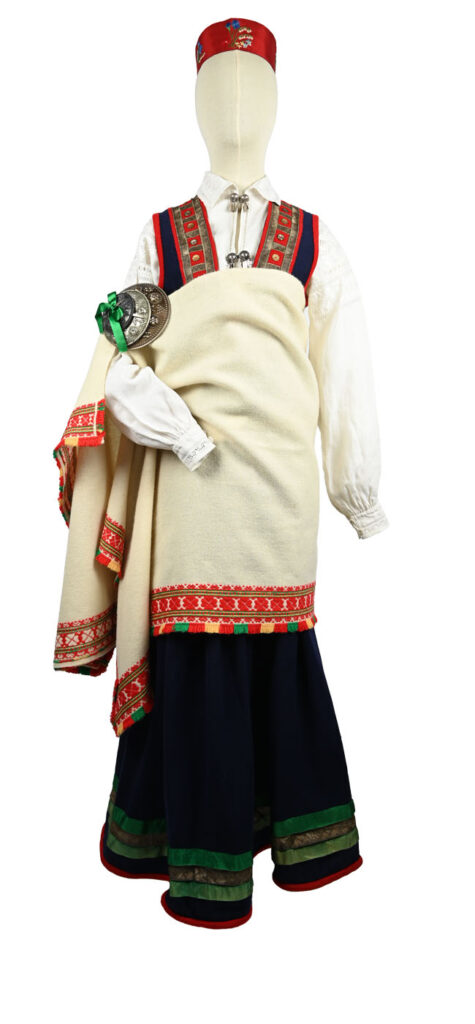
Home > Taken Out of Latvia > Handmade by a Kaucminde Student Handmade by a Kaucminde Student Rucava folk costume. Made by Vera Anna Uskalis (1921–2013) ca 1943 in Latvia. This folk costume was made at the Kaucminde Home Economics Seminary, where Vera Anna Uskalis learned domestic and agricultural skills. Vera took the folk costume with her when she fled as a refugee during WWII. The folk costume and its owner first landed in a refugee camp in Greven, Germany, then eventually settled in Leeds, UK. The folk costume was later given to Vera’s niece, Zinta Uskale, who took it with her when she moved for a while to the Latvian centre “Abrene” in France. In 2015 the folk costume was brought back to Latvia. Donated by Ilona Uskalis; from the collection of the Latvians Abroad Museum and Research Centre (LP2022.434). Zinta Uskalis (on the right) wearing the Rucava folk costume made by Vera Uskalis in Northern England in the 1980s. Donated by Ilona Uskalis. From the collection of the Latvians Abroad Museum and Research Centre.
A Sister’s Folk Costume
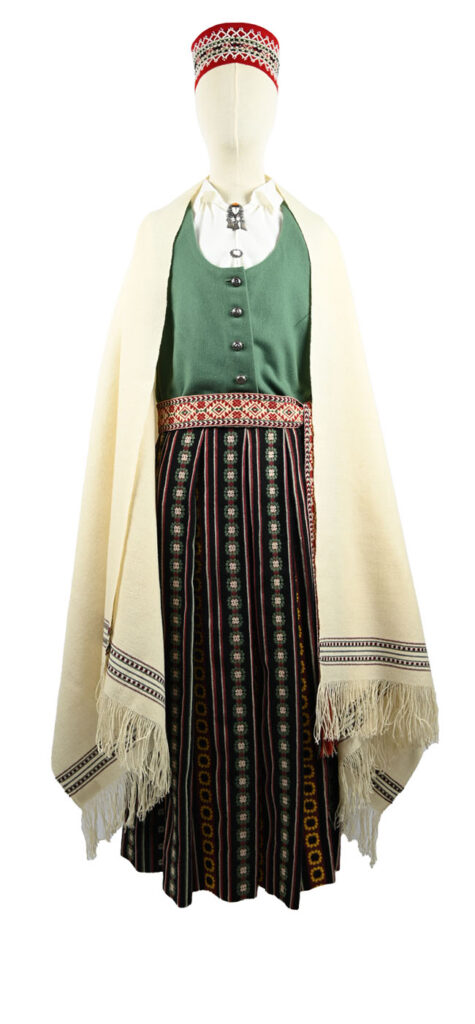
Home > Taken Out of Latvia > A Sister’s Folk Costume A Sister’s Folk Costume Zemgale folk costume. Made by Aina Ramane (née Besere, 1922–2012) in the 1930s in Latvia. Aina Ramane made the Zemgale folk costume, maiden’s headdress, and sash while studying at the Zaļenieki School of Home Economics. The pendant brooch was made of silver by a craftsman in Jelgava in 1938. Aina took the costume with her as a refugee during WWII; from Germany Aina moved to the USA. There she commissioned the jeweller Antons Kivelnieks from Toronto, Canada, to make a circle brooch and silver buttons for the folk costume’s vest. The shawl for the costume was woven by master weaver Ausma Siliņa in Syracuse, USA, but without the traditional tablet-woven border because Siliņa could no longer undertake such a complex job at her age. The shirt has been mended several times as it has worn out over the years. Aina eventually gave the folk costume to her sister, Vita Ramane, who wore it when performing with the New York Latvian Lutheran Church choir and in the New York kokle and song ensemble led by Andrejs Jansons. This Zemgale folk costume has seen many performances on stages all over the world. Donated by Vita Ramane; from the collection of the Latvians Abroad Museum and Research Centre (LP2017.1435). Aina Ramane in her own handmade Zemgale folk costume (3rd from left in row 3) with school friends in the park near the Zaļenieki School of Home Economics on 15 May 1938. Donated by Vita Ramane. From the collection of the Latvians Abroad Museum and Research Centre.
A Skirt Made From a Dyed Blanket
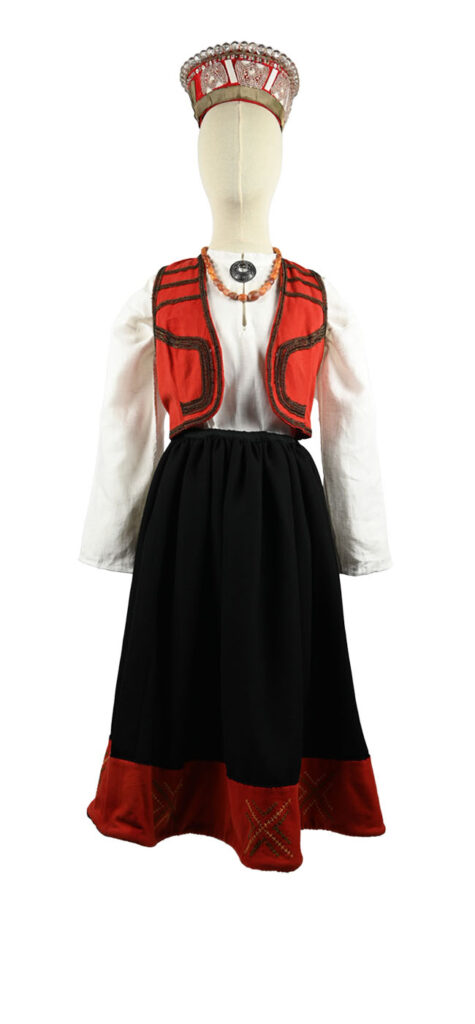
Home > In Refugee Camps > Making folk costumes in refugee camps > A Skirt Made From a Dyed Blanket A Skirt Made From a Dyed Blanket Bārta folk costume. Made by Vera Puķe-Puķīte (1915–2014) in 1946, in Denmark. The folk costume was made in a refugee camp in Denmark. Vera Puķe-Puķīte, the maker of the costume, recalls: “You know what the Latvians did? They dyed woollen bedspreads black! And they sewed skirts from them, and on the bottom edge they put a red ribbon on which they had embroidered those folk designs. They really wanted the children to be dressed in the folk manner, too. None of us adults had any folk costumes back then. We had just what we had brought from Latvia… Who could have brought a folk costume along?! It wasn’t something people thought about. They just thought about what was necessary and could be put in a few bags, and that was it.” Donated by Vera Puķe-Puķīte; from the collection of the Latvians Abroad Museum and Research Centre (LP2015.225). Children’s folk dance ensemble “Jautrais Pāris” dancing at the Northern Camp in Wurzburg around 1947. Photo by Teodors Kauls (sen.). Donated by Margarita Stīpniece. From the collection of the Latvians Abroad Museum and Research Centre.
A Girl’s Folk Vest Made From a Nazi Flag
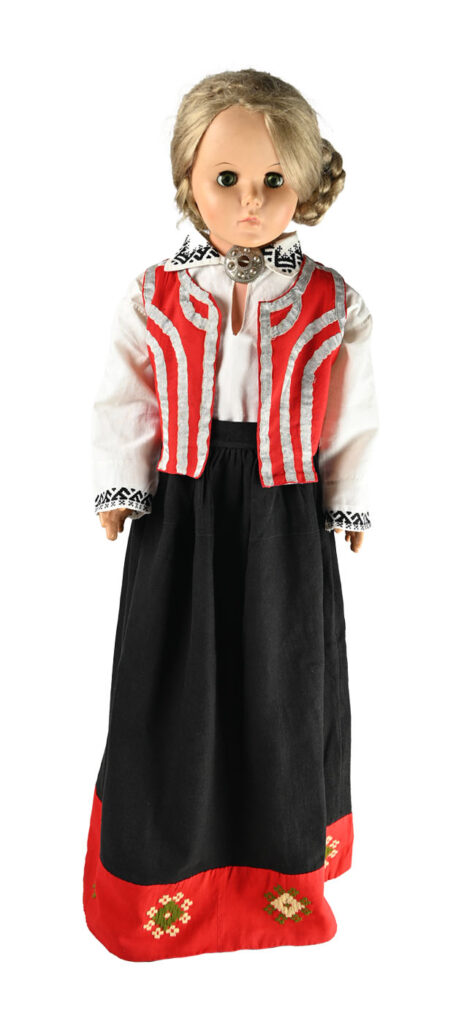
Home > In Refugee Camps > Making folk costumes in refugee camps > A Girl’s Folk Vest Made From a Nazi Flag A Girl’s Folk Vest Made From a Nazi Flag The national costume of Bārta. Made by Milda Sāns (1915–1968) in 1947, in Germany. Milda Sāns made this costume for her three-year-old daughter Laura when the fleeing family had arrived in Fellbach, Germany, in 1947. The skirt was made from black black-out curtains. The red vest and bottom edging of the skirt were made from the fabric of a Nazi flag. The shirt was made from a bed sheet. Laura wore this folk costume at the Esslingen Song Festival in 1947 and other Latvian events. Later, in Sweden, the folk costume was lent to Paula Blumkviste, who wore it to the 1979 Song Days in Gotland, which were organised by the World Federation of Free Latvians. Donated by Laura Sāns; from the collection of the Latvians Abroad Museum and Research Centre (LP2023.51.1-3). Laura Sāns in Fellbach, Germany, 1947. Donated by Laura Sāns. From the collection of the Latvians Abroad Museum and Research Centre.
A Shirt Embroidered by Mum
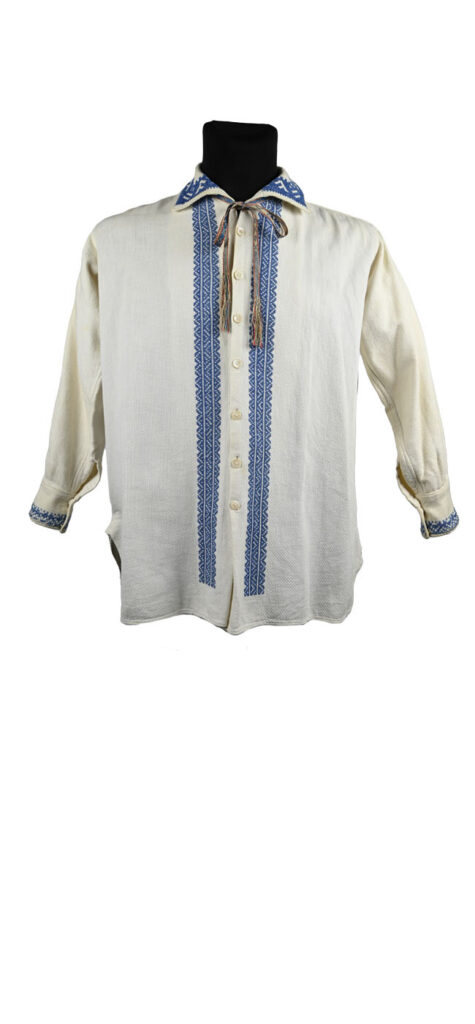
Home > In Refugee Camps > Making folk costumes in refugee camps > A Shirt Embroidered by Mum A Shirt Embroidered by Mum Shirt and woven ribbon. Made by Emma Zemītis (1900–1965) in the late 1940s, in Germany. Emma Zemītis made this folk costume shirt for her son Juris around 1947, when they lived in the “Saule” refugee camp in Geesthacht, Germany. It was made from British army dish towels. The woven ribbon was made by Juris’ schoolmate Vija Vilde – it was the very first ribbon she ever wove. Juris wore the shirt while dancing folk dances in Germany, and later, in Australia. Donated by Juris Zemītis; from the collection of the Latvians Abroad Museum and Research Centre (LP2015.108-109). Dancers wearing Latvian folk shirts at the “Saule” DP camp in Geesthacht, Germany, in the late 1940s. Donated by Juris Zemītis. From the collection of the Latvians Abroad Museum and Research Centre.