
Identical Folk Costumes for Four Brothers
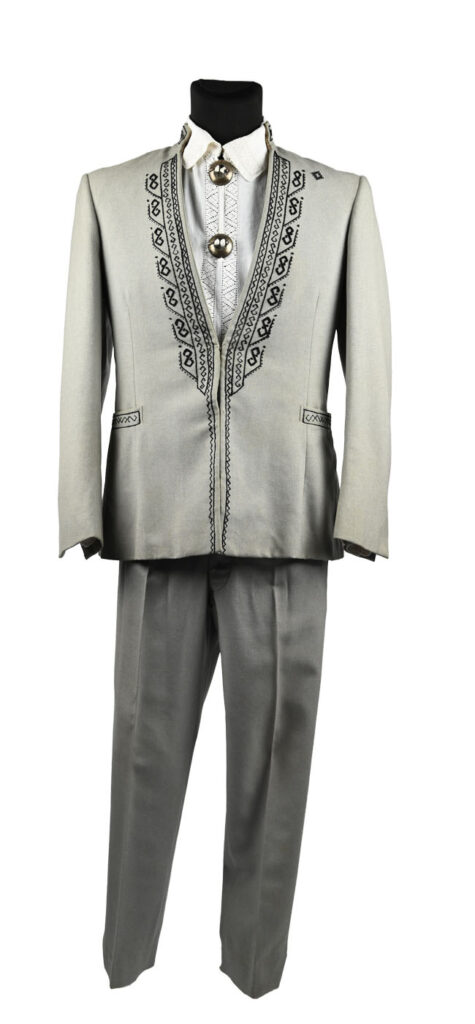
Home > In Exile > Home-made folk costumes > Identical Folk Costumes for Four Brothers Identical Folk Costumes for Four Brothers Nīca folk costume. Made by Arvīds Tilaks (1922–1987) in Corby, UK, ca. 1966. The national costume belonged to the wonderful chef, entrepreneur and culinary show presenter Mārtiņš Rītiņš (1949–2022). It was the only folk costume he ever wore. Mārtiņš first wore the folk costume in England, performing with the “Pērkonītis” folk dance group in Corby; in the second half of his life, he wore it in Latvia when singing with the “Mārtiņkoris” choir. In 1964, when the “Pērkonītis” folk dance group was preparing to perform at the European Latvian Song Festival in Hamburg, Hermīne Rītiņa commissioned identical folk costumes for her older sons from Arvīds Tilaks, a Latvian tailor living in Corby. It is believed that Hermīne herself embellished the coats by embroidering Latvian designs. In 1966 a folk costume was also ordered for her youngest son, Mārtiņš. That year “Pērkonītis”, together with the “Kamoliņš” folk dance group, went on a concert tour to Germany and Belgium. While Mārtiņš was dancing in “Pērkonītis”, the folk costume experienced various events in many parts of the world, such as the 5th Latvian Song Festival in Toronto, Canada, in 1970, and the famous “Rose of Tralee” folk festival in Ireland, in 1972. The “Pērkonītis” folk dance group also danced in their folk costumes at the wedding reception for Queen Elizabeth’s father’s nephew, Prince Richard of Gloucester, at the family’s Barnwell Castle estate. Donated by the Rītiņš family. From the collection of the Latvians Abroad Museum and Research Centre (LP2023.3.1-5). From right to left: Mārtiņš Rītiņš with his brother Andrejs wearing Nīca folk costumes made by their mother Hermīne. Donated by the Rītiņš family. From the collection of the Latvians Abroad Museum and Research Centre.
A Folk Costume In Spite of the Pain
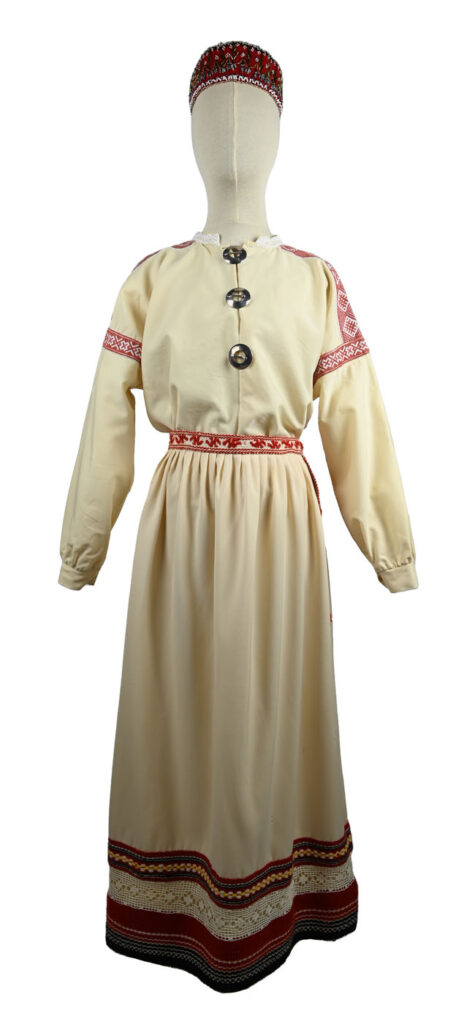
Home > In Exile > Home-made folk costumes > A Folk Costume In Spite of the Pain A Folk Costume In Spite of the Pain Abrene folk costume. Made by Elza Emīlija Mežmalis (née Tupētāja, 1906–1992) in Brisbane, Australia, in 1987. Elza Emīlija Mežmalis made this Abrene folk costume for her daughter Maiga Mezmale. Elza had learned handicraft skills – weaving, sewing, embroidery – in Latvia, at the beekeeping school in Vecbebri. The Abrene folk costume was made when Elza was 81 years old and suffering from arthritis, which she had acquired after sewing horse saddles for many years at Butler Brothers Saddlery in Brisbane. She continued to sew every day to keep her finger joints agile. The folk costume for her daughter Maiga was made using only materials from home, including parts of her daughter’s previous Nīca folk costume. Due to her health, Elza could not embroider the blouse designs, so she replaced them with ribbons she had woven herself. The bottom edge of the Abrene skirt was also woven by Elza. Maiga wore the national costume when participating in Australian Latvian Arts Festivals and other Latvian community events. Donated by Marga Laima Wren. From the collection of the Latvians Abroad Museum and Research Centre (LP2020.400). Maiga Mežmale in her Abrene folk costume in the late 1980s. Donated by Marga Laima Wren. From the collection of the Latvians Abroad Museum and Research Centre. A Folk Costume In Spite of the Pain Playing Previous Song Play Pause Next Song /
Fabric From Home, Across the Sea
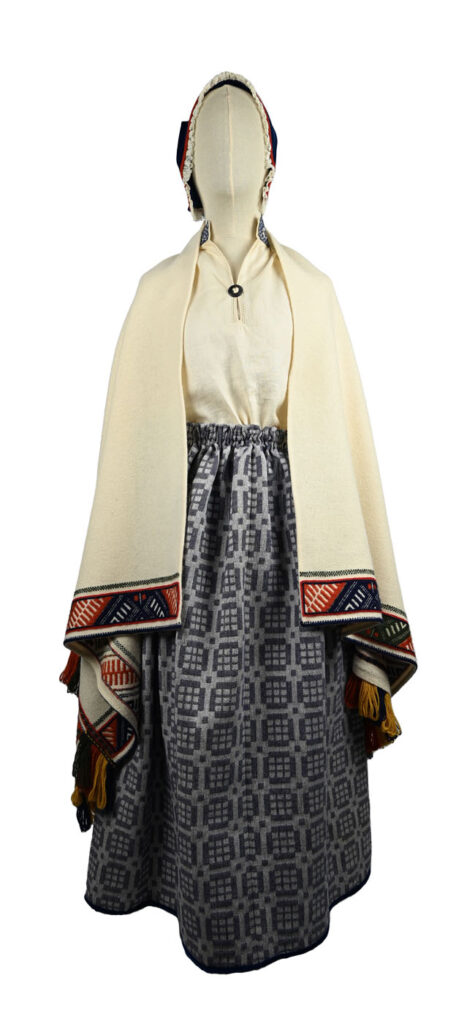
Home > In Exile > Home-made folk costumes > Fabric From Home, Across the Sea Fabric From Home, Across the Sea Saka folk costume. Made by Sofija Sinka (née Zommere, 1924–2014) in the 1960s, in Molkom, Sweden. Sofija Zommere and her brother fled to Sweden in 1944, disembarking from a refugee boat on the coast of Gotland. Sofija had taken along from Latvia home-woven fabric for a Saka folk costume skirt. In the early years of exile, Sofija sang in Teodors Reiters’ choir in Stockholm. When Sofija married the artist and pharmacist Imants Sinka in 1952, the family moved to Molkom, Värmland. There she made her own Saka folk costume using the fabric she had brought with her when fleeing Latvia. Donated by Silvija Sinka. From the collection of the Latvians Abroad Museum and Research Centre (LP2023.52.1-5). Sofija Sinka in her homemade Saka folk costume at her home in Molkom, Värmland, Sweden, in the 1960s. Donated by Sofija Sinka. From the collection of the Latvians Abroad Museum and Research Centre.
Bashkirian version of a Latvian folk costume
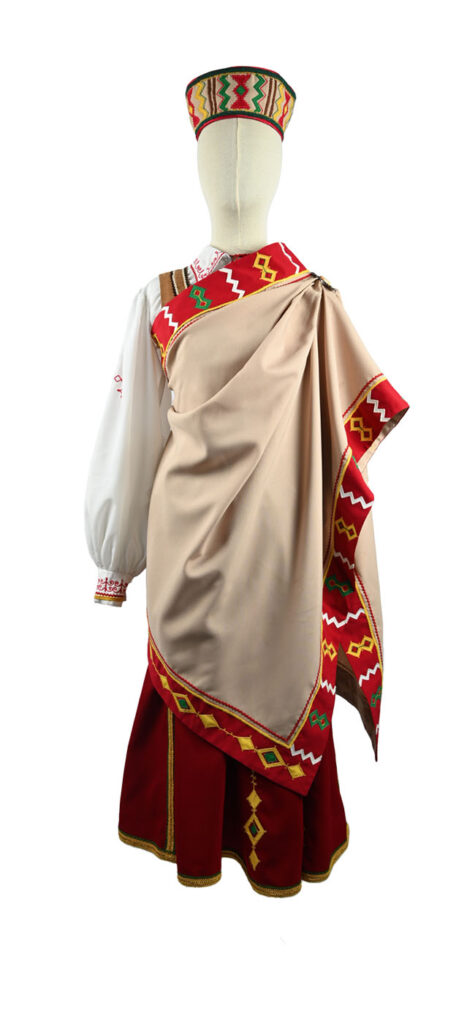
Home > In Exile > “Composite” and adapted folk costumes > Bashkirian version of a Latvian folk costume Bashkirian version of a Latvian folk costume Latvian folk costume made in 2004 in Bashkiria, Russia. The folk costume was made in 2004 in Bashkiria as a stage costume for the “Atbalss” Latvian folklore ensemble. The inspiration for the folk costume has not yet been identified. It was one of the first folk costumes worn by the folklore ensemble and has been worn by children of at least three generations as they performed at various events, including at the Maxim Gorky School, in the Arkhangelsk Oblast, in the Republic of Bashkortostan, and elsewhere in Russia. A few years later, new folk costumes were made. Ten years ago, the ensemble received “real” made-in-Latvia folk costumes. Teachers travelled from Latvia to teach the Latvian language, songs and dances at the Maksim Gorky Village School to the Latvian descendants living in Bashkiria; the teachers thought this colourful and stylised folk costume, with its atypical patterns and strange shawl, was “a very peculiar interpretation of the Latvian folk costume”. Yet the girls of the folklore ensemble wore the folk costume with great joy. As Latvian-language teacher Kristīne Apse, who worked in Bashkiria during the 2004–2005 school year, recalls: “The girls wore the folk costume and were very happy! Life is life. You have to accept that everything flows and changes – it’s better to have some Latvian elements in a folk costume than none at all!” Donated by Ilona Saverasa, from the collection of the Latvians Abroad Museum and Research Centre (LP2015.122). The “Atbalss” Latvian folklore ensemble at the first Latvian Song Festival in Bashkiria in 2009. Photo by Arta Savdona. From the collection of the Latvians Abroad Museum and Research Centre. Bashkirian version of a Latvian folk costume Playing Previous Song Play Pause Next Song /
A Folk Costume Pieced Together From Several Countries
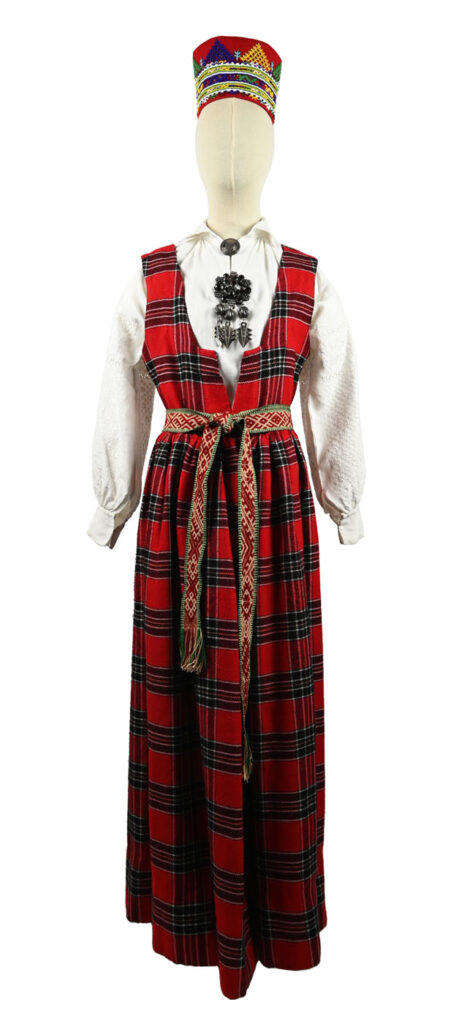
Home > In Exile > “Composite” and adapted folk costumes > A Folk Costume Pieced Together From Several Countries A Folk Costume Pieced Together From Several Countries Lielvārde folk costume. Made by Ilona Gulbis (born 1939) in São Paulo, Brazil, in the 1950s. Lielvārde woven belt. Made in Latvia, brought from Latvia as a refugee. When Ilona Gulbis was about 14 years old, she started to make a folk costume for herself. Ilona remembers that she bought the linen herself: “One with a clear and precise weave, where you could pull out threads and count the stitches exactly. And so I slowly made my blouse. It’s my own handiwork – whitework. I made it in a larger size and so I’ve worn it all these years.” Ilona made the Lielvārde skirt from wool-blend fabric bought in a shop. She bought the brooches and the woven belt in America. The belt was woven by a disabled war veteran; the jewellery was made by metalsmith Augusts Telle in Chicago. The folk costume’s headdress was made at Ilona’s request by master handicrafter Marija Ošeniece in Brazil. Ilona’s reason for choosing the Lielvārde folk costume is clear and concise: “I liked it! I was fascinated by the legend of Lāčplēsis!” When Ilona donated the folk costume to the museum, she decided to keep the Lielvārde woven belt as a memento. Costume donated by Ilona Gulbis. Belt donated by Dzidra Ērika Daykin. From the collection of the Latvians Abroad Museum and Research Centre (LP2015.222 – costume, LP2022.549.5 – belt). The Latvian stand at the 1988 immigrant exhibition in Ibirapuera, São Paulo, Brazil. From left: Ilona Gulbis in her Lielvārde folk costume, Vicente Bicudo. Donated by Ilona Gulbis. From the collection of the Latvians Abroad Museum and Research Centre. A Folk Costume Pieced Together From Several Countries Playing Previous Song Play Pause Next Song /
Folk Costume With an Argentine Gaucho Belt
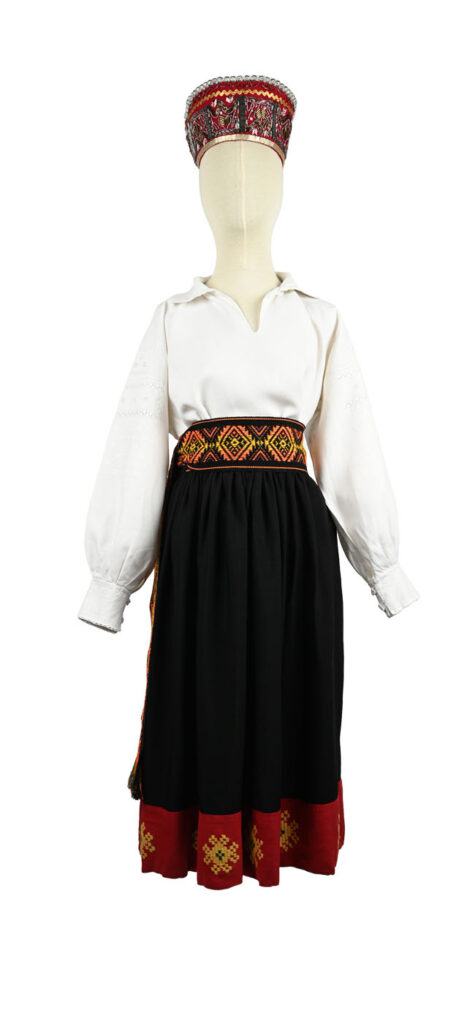
Home > In Exile > “Composite” and adapted folk costumes > Folk Costume With an Argentine Gaucho Belt Folk Costume With an Argentine Gaucho Belt Bārta folk costume. Made by Mrs Arāja in Argentina, 1950s. The Bārta folk costume was made by Mrs Arāja in Buenos Aires for the Latvian-Argentinian Anna Drabis-Streļčūna. As there were no Latvian belt weavers in Argentina, a gaucho belt made in Argentina with patterns similar to Latvian ornamentation was added to the costume. Ever since Latvian war refugees arrived in Argentina in the 1950s, folk costumes have been worn at various Latvian festivals, theatre performances and choir concerts. This Bārta folk costume is still in use today – Astrīda Streļčūna wears the national costume inherited from her grandmother every year to proudly carry the flag of Latvia into the hall for Latvia’s Independence Day celebration. On loan from Jānis Streļčūns. Astrīda Strelčūna in the Bārta folk costume (first from right) with other Latvian-Argentinian descendants and an Argentinian gaucho dancer in the courtyard of the church of the Congregation of La Resurreccion in the Buenos Aires suburb of Hurlingham, Brazil, on 19 November 2017. Photo by Brigita Tamuža.
From Alsunga to Australia and Back
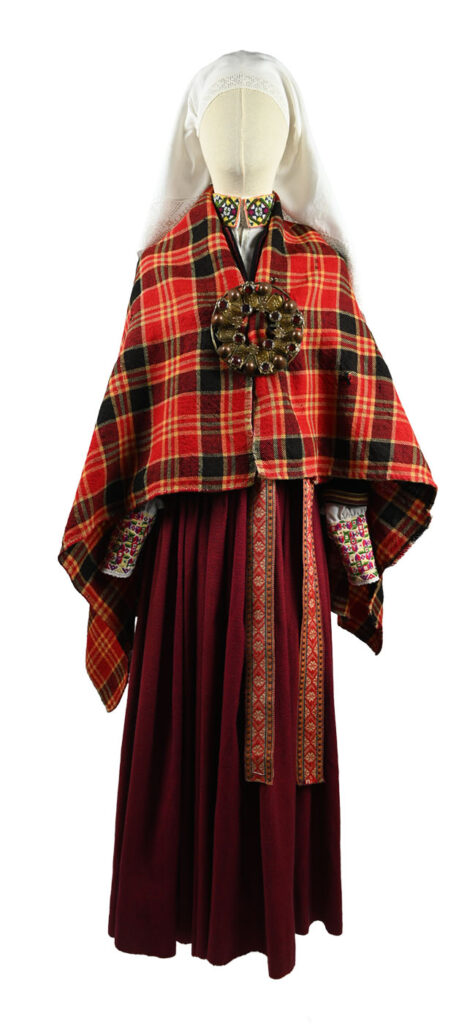
Home > In Exile > “Composite” and adapted folk costumes > From Alsunga to Australia and Back From Alsunga to Australia and Back Alsunga folk costume. Individual parts of the garment were made in Alsunga, Latvia, in the 19th and 20th centuries, and others in Australia in the 1970s. The Alsunga folk costume once belonged to Latvian-Australian Māra Siksna. The brooch, woven belt and shawl were given to Māra by Elfrīda Bikauniece, who bought parts of the Alsunga folk costume while walking around and knocking on people’s doors in the Alsunga area in the 1930s. The large antique brooch was given as a gift – it was found in the clay while digging the foundations for a barn. When Elfrīda fled Latvia in 1944, she used the colourful Alsunga shawl as a rucksack into which she folded the antique brooch and a few favourite paintings. “During difficult times, I often felt that the old brooch was like a talisman, a guardian angel that helped me escape from danger and gave me spiritual strength,” Elfrīda told Māra. In 1976, when the “Saules josta” dance ensemble was about to embark on an Australian and world tour with a dance and song performance, Māra Siksna decided to make the missing parts of the Alsunga folk costume so that she could show the antique brooch, belt and shawl to the world. Together with Māra, the Alsunga folk costume has been on stage at the Sydney Opera House; has performed with “Saules josta” in Australia, Canada, the USA, Sweden and England; and has taken part in Australian Latvian Arts Festivals and Latvian Song Festivals in Canada, Germany and Latvia. Māra has also worn the folk costume at political street demonstrations for Baltic freedom and at formal receptions at the Brisbane Parliament. The folk costume has now returned to Alsunga, the land of the Suiti people. On loan from Alsungas amatu māja. Māra Siksna in her Alsunga folk costume in Munster, Germany, in 1984. Donated by Māra Siksna. From the collection of the Latvians Abroad Museum and Research Centre. From Alsunga to Australia and Back Playing Previous Song Play Pause Next Song /
A Folk Costume for the Brazilian Climate
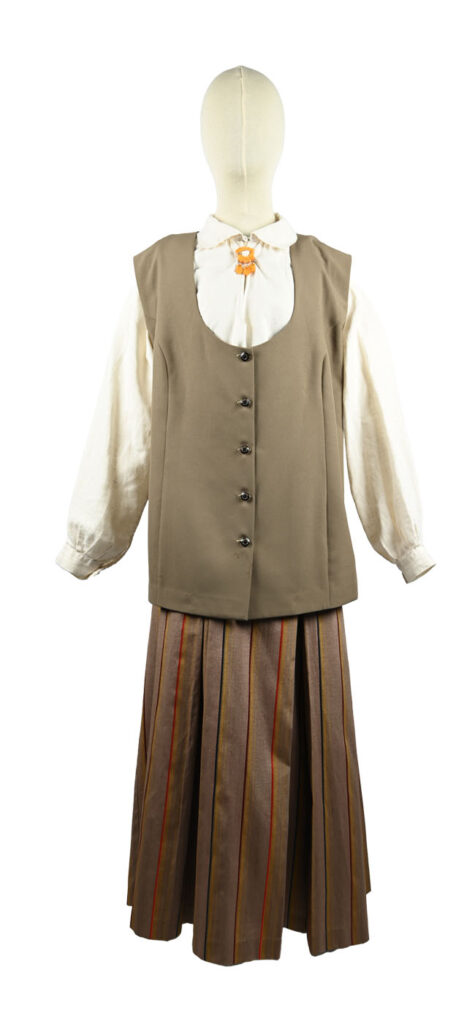
Home > In Exile > “Composite” and adapted folk costumes > A Folk Costume for the Brazilian Climate A Folk Costume for the Brazilian Climate Made by Liana Arais Pydd in Ijuí, Brazil, in the late 1990s. Latvian-Brazilian Liana Arais Pydd used a thin and breathable striped fabric in shades of brown to make the dress. She wore pastalas (trad. leather footwear) on her feet and sometimes tied a woven belt around her head instead of wearing a crown or headdress. Liana says: “This is one of my folk costumes that I used to wear, and it reflects quite well the difficulties that people in Brazil have to go through. It’s hard to wear Latvian folk costumes from December to March because they are very warm.” Liana wore the folk costume to events at the Brazilian Latvian Centre, and once to a ball at the “Fenadi” ethnic community festival in Ijuí. Donated by Liana Arais Pydd. From the collection of the Latvians Abroad Museum and Research Centre (LP2023.22.1-2). Liana Arais Pydd in one of her handmade stylised folk costumes at the ethnic community ball in Ijuí, Brazil, in 2015. From left: Armindo Pydd, Liana Arais Pydd, Maiga Arais, Eronita Arais. Donated by Liana Arais Pydd. From the collection of the Latvians Abroad Museum and Research Centre. A Folk Costume for the Brazilian Climate Playing Previous Song Play Pause Next Song /
A Folk Costume for Folk Dancing in Ijuí
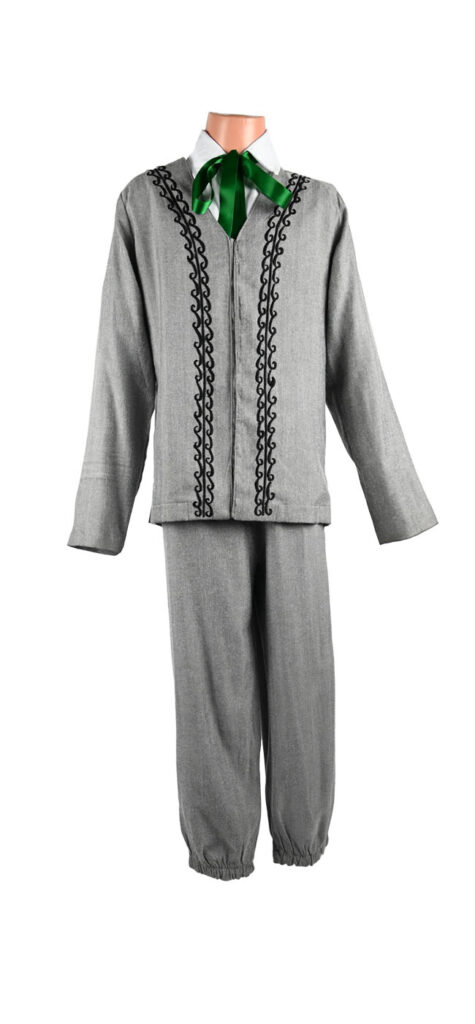
Home > In Exile > “Composite” and adapted folk costumes > A Folk Costume for Folk Dancing in Ijuí A Folk Costume for Folk Dancing in Ijuí Folk costume. Made in Ijuí, Brazil, 1991. The costume was made for the “Jautrais pāris” children and youth dance group in Ijuí. It was made from ethnographic drawings. The costume was made by two seamstresses – one pieced it together and the other embellished it with embroidery. The embroidery was done not by hand but by machine. Donated by Mara Susana Ceratti Salas. From the collection of the Latvians Abroad Museum and Research Centre (LP2023.108) Latvian folk costumes are paraded at the “Fenadi” multicultural festival in Ijui, Brazil, 2006. From the collection of the Latvians Abroad Museum and Research Centre.
Graduation Attire
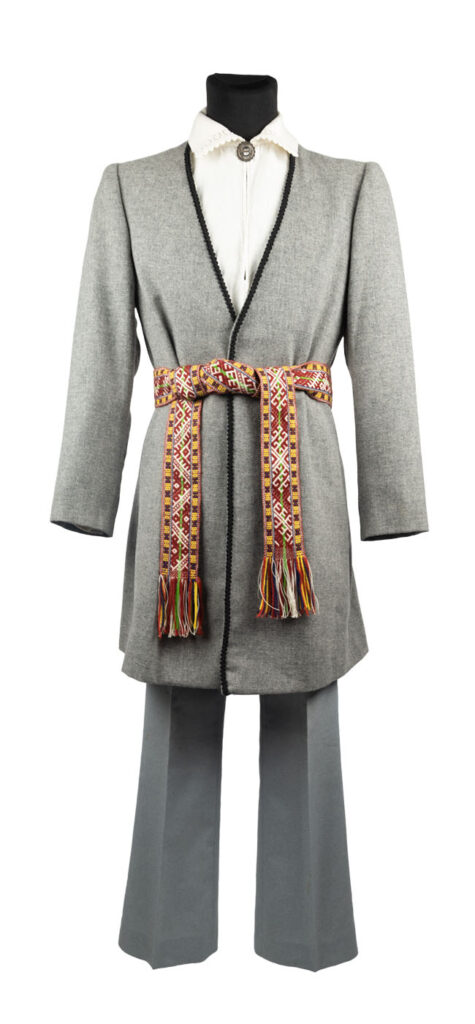
Home > In Exile > Folk costumes – not just for the stage > Graduation Attire Graduation Attire Men’s folk costume. Made in the USA, 1980s. The folk costume belonged to Latvian-American Kristaps Hinkle (1966–2017). It was made when Kristaps began his studies at the Gaŗezers Summer High School. Kristaps also wore the folk costume while dancing in the “Mēnestiņš” folk dance ensemble in Syracuse. He also took part in Syracuse’s annual Festival of Nations, where dancers in folk costumes presented the Latvian cultural programme. Kristaps also performed in this folk costume at other events organised by the Baltic community, as well as at song and dance festivals in Canada and America. He also wore the folk costume while studying at the Latvian Studies Center in Kalamazoo, MI, USA. Donated by Maija Hinkle. From the collection of the Latvians Abroad Museum and Research Centre (LP2020.96). Kristaps Hinkle in his folk costume at the graduation ceremony of the Gaŗezers Summer High School in 1985. Donated by Maija Hinkle. From the collection of the Latvians Abroad Museum and Research Centre.